
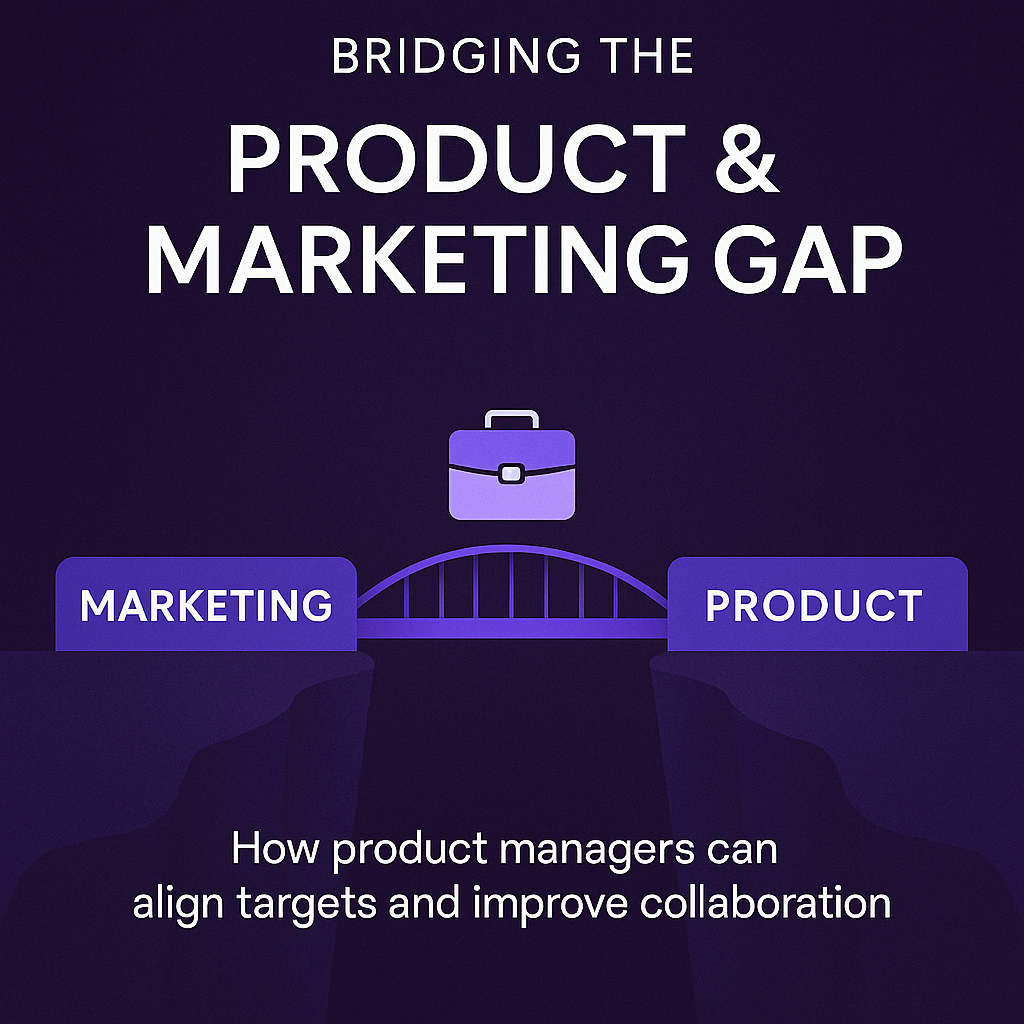
Bridging the Product & Marketing Gap
How product managers can turn friction into alignment and build shared growth momentum.
Published on ·
Why Product & Marketing Drift Apart
In fast-moving organizations, product and marketing often drift apart — not from incompetence, but from misaligned incentives. Marketing chases lower CAC and volume. Product optimizes for conversion and retention. The result? A funnel full of leads that don’t activate, and finger-pointing between teams.
When this happens, growth slows — not because either team is failing, but because they’re running different races on the same track.
The Product Manager as Translator
Enter the product manager — the bridge between growth and experience. The PM’s unique position allows them to translate strategy into shared understanding. Instead of mediating conflict, they align incentives.
- Shared metrics: Replace vanity KPIs with a common goal like “Cost per Activated User”.
- Joint experiments: Design experiments where marketing efficiency and in-product activation are measured together.
- Data storytelling: Turn analytics into shared narratives — insights that connect cause and effect across teams.
Facilitating Collaboration, Not Blame
Misalignment isn’t solved by meetings — it’s solved by structure. PMs can create frameworks that make collaboration habitual, not situational:
- Shared quarterly planning: Co-create goals that link acquisition inputs to retention outputs.
- Cross-functional retros: Debrief together after launches — treating performance as a shared outcome.
- Define boundaries clearly: Marketing owns channels; product owns experiences. But both own the user journey.
Creating a Culture of One Funnel
True growth happens when product and marketing see themselves as two halves of one funnel. That culture requires humility, data transparency, and a PM who constantly reinforces the connection between acquisition and activation.
“Marketing brings users to the door; product keeps them inside. Real success happens when both teams agree on what the door looks like.”
Lesson in one line: Alignment isn’t a process — it’s a mindset. Great PMs make teams see the same customer, not just the same dashboard.